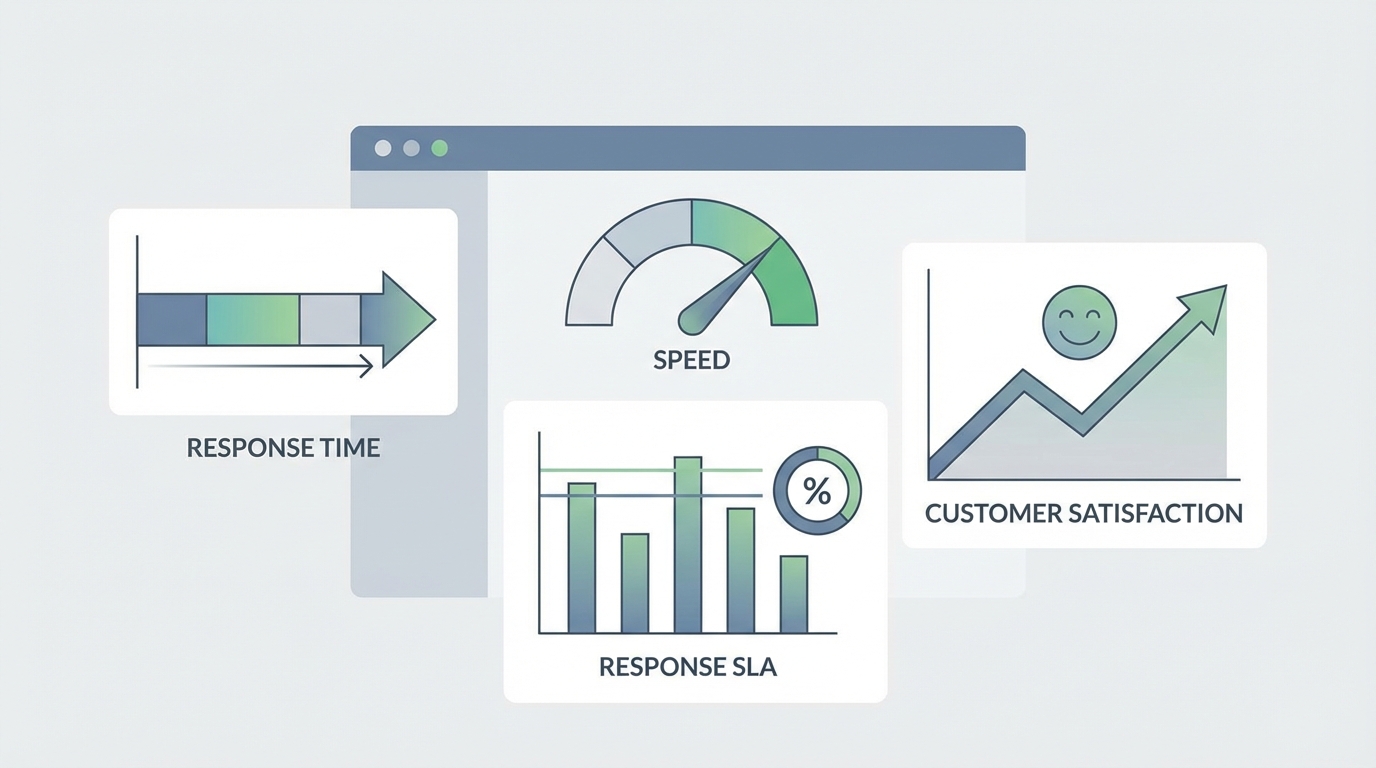
The Response Time Gap
Here's a stat that should keep every business owner up at night: the average business takes 3.5 days to respond to a negative review. Some never respond at all.
Meanwhile, research shows that customers expect a response within 24 hours — and ideally much sooner. The gap between expectation and reality is where reputation damage happens.
The businesses that have figured out how to close this gap are seeing measurable improvements in customer retention, rating recovery, and revenue.
The Data on Response Time
Resolution Rates by Speed
| Response Time | Issue Resolution Rate | Rating Update Rate |
|---|---|---|
| Under 1 hour | 70% | 33% update to higher rating |
| 1–4 hours | 55% | 22% update |
| 4–24 hours | 40% | 12% update |
| 1–3 days | 25% | 5% update |
| 3–7 days | 15% | <2% update |
| 7+ days | <5% | Almost never |
The pattern is clear: every hour you delay cuts your chances of resolution.
Why Speed Matters So Much
1. Emotional Window
A customer who just left a bad review is still emotionally engaged. They're upset, but they're also still connected to the experience and open to resolution. After 24 hours, emotions cool — but so does their willingness to give you a second chance.
2. The Audience Is Watching
Every hour a negative review sits unanswered is an hour where potential customers see it and form conclusions. The review itself is damaging, but the lack of response is more damaging. It signals indifference.
3. Search Engine Signals
Google's algorithm rewards businesses that actively engage with reviews. Faster response times contribute to:
- Higher local pack rankings
- Better "responsiveness" signals
- More keyword-rich content (from response text)
- Increased engagement metrics
4. Competitive Advantage
If you respond in 30 minutes and your competitor responds in 3 days, potential customers notice. Speed of response is a proxy for quality of care.
Why Businesses Are Slow to Respond
Manual Platform Checking
Most businesses "monitor" reviews by logging into Google, Yelp, Facebook, and other platforms individually. This manual process introduces delays:
- Staff forgets to check
- Reviews come in on weekends when nobody's watching
- Some platforms are checked daily, others weekly
No Alert System
Without real-time alerts, review discovery is reactive and inconsistent. A review posted Friday evening might not be seen until Monday morning — 60+ hours later.
No Clear Ownership
When nobody specifically owns review response, nobody responds. "Someone should reply to that" turns into "I thought you were handling it."
Slow Response Drafting
Writing a thoughtful, professional response takes time. When staff has to craft each reply from scratch, the cognitive burden leads to procrastination.
The Fast Response Framework
1. Real-Time Monitoring
Replace manual platform checking with automated monitoring that sends alerts the moment a new review appears.
MentionReview delivers alerts via:
- Slack — review appears in a channel within seconds
- Email — instant notification with full review text and sentiment
- Push notifications — mobile alerts for urgent reviews
2. Clear Ownership Matrix
Define who responds to what:
| Review Type | Owner | Escalation |
|---|---|---|
| Positive (4–5 stars) | Any team member | None needed |
| Mildly negative (3 stars) | Shift manager | If unresolved in 4 hours |
| Very negative (1–2 stars) | Owner/GM | Immediate |
| Legal/health mentions | Owner | Immediate + legal review |
| Employer reviews (Indeed) | HR | Weekly review |
3. AI-Assisted Drafting
Use AI to generate response drafts that team members can review and personalize. This reduces response drafting from 5–10 minutes to under 60 seconds.
The workflow:
- Alert arrives in Slack
- Click through to see review + AI-suggested response
- Edit if needed (or approve as-is)
- Send
Total time: under 2 minutes from review posted to response sent.
4. Response Templates
For common scenarios, maintain templates that can be quickly customized:
- Standard positive review thank-you
- Negative review apologize + offer to resolve
- Constructive feedback acknowledgment
- "We can't find your visit" for suspicious reviews
5. Mobile Response Capability
Reviews don't only come in during business hours. Your monitoring tool should allow responses from mobile so you can handle urgent reviews on the go.
Measuring Response Time Performance
Key Metrics to Track
Average Response Time (ART) The mean time between review publication and your response. Track this per platform and per team member.
First Response Rate (FRR) The percentage of reviews that receive a response. Target: 100% for negative reviews, 80%+ for positive.
Under-1-Hour Rate The percentage of negative reviews responded to within 60 minutes. This is your gold standard metric.
Resolution Rate Of the reviews you responded to, how many resulted in:
- A rating change (upgrade)
- A follow-up positive review
- A direct message/email to resolve
Setting Realistic Targets
| Metric | Good | Great | World-Class |
|---|---|---|---|
| Avg response time (negative) | <24 hours | <4 hours | <1 hour |
| First response rate | >80% | >95% | 100% |
| Under-1-hour rate | >20% | >50% | >80% |
| Resolution rate | >25% | >40% | >60% |
Case Study: The Speed Effect in Action
Consider two identical restaurants:
Restaurant A — Responds to reviews once a week (batch processing)
- Average response time: 4.2 days
- Rating: 3.9 (declining)
- Unresolved complaints: many
- Customer sentiment: "They don't care"
Restaurant B — Uses real-time monitoring with AI responses
- Average response time: 47 minutes
- Rating: 4.4 (stable/improving)
- Resolved complaints: 65%
- Customer sentiment: "Great customer service"
Same food, same service, same occasional mistakes. The difference is awareness and response speed.
The Compounding Effect
Fast response creates a virtuous cycle:
- Quick response → customer feels heard
- Customer updates review → rating improves
- Better rating → more new customers
- More customers → more reviews (mostly positive)
- More positive reviews → even better rating
- Better rating → better search ranking
- Better ranking → even more customers
The opposite is equally true. Slow response creates a doom loop where negative reviews pile up, ratings drop, and fewer customers come in.
Getting Started
If you're currently averaging days between reviews and responses, here's your roadmap:
Week 1: Set Up Monitoring
Sign up for MentionReview (free plan), connect your business locations, and configure Slack/email alerts. Immediate improvement: you'll know about reviews the same day.
Week 2: Establish Ownership
Assign review response to specific team members. Create a simple rotation if needed.
Week 3: Implement AI Responses
Start using AI-suggested responses. Initial time investment: 2 minutes per review instead of 10.
Week 4: Optimize
Review your first month's metrics. Set targets for the next month. Aim to cut average response time in half each month until you're consistently under 4 hours.
Month 3: Maintain
By now, fast review response should be a habit, not a project. The AI suggestions keep getting better as you use them.
Cut your response time to minutes. Start monitoring with MentionReview. Free plan available — no credit card required.