AI Has Changed Everything About Review Monitoring
Two years ago, review monitoring meant setting up Google Alerts and manually checking Yelp every morning. You'd read each review, decide if it mattered, and spend 10 minutes crafting a response. Multiply that by 5 platforms and 10 locations, and you had a full-time job.
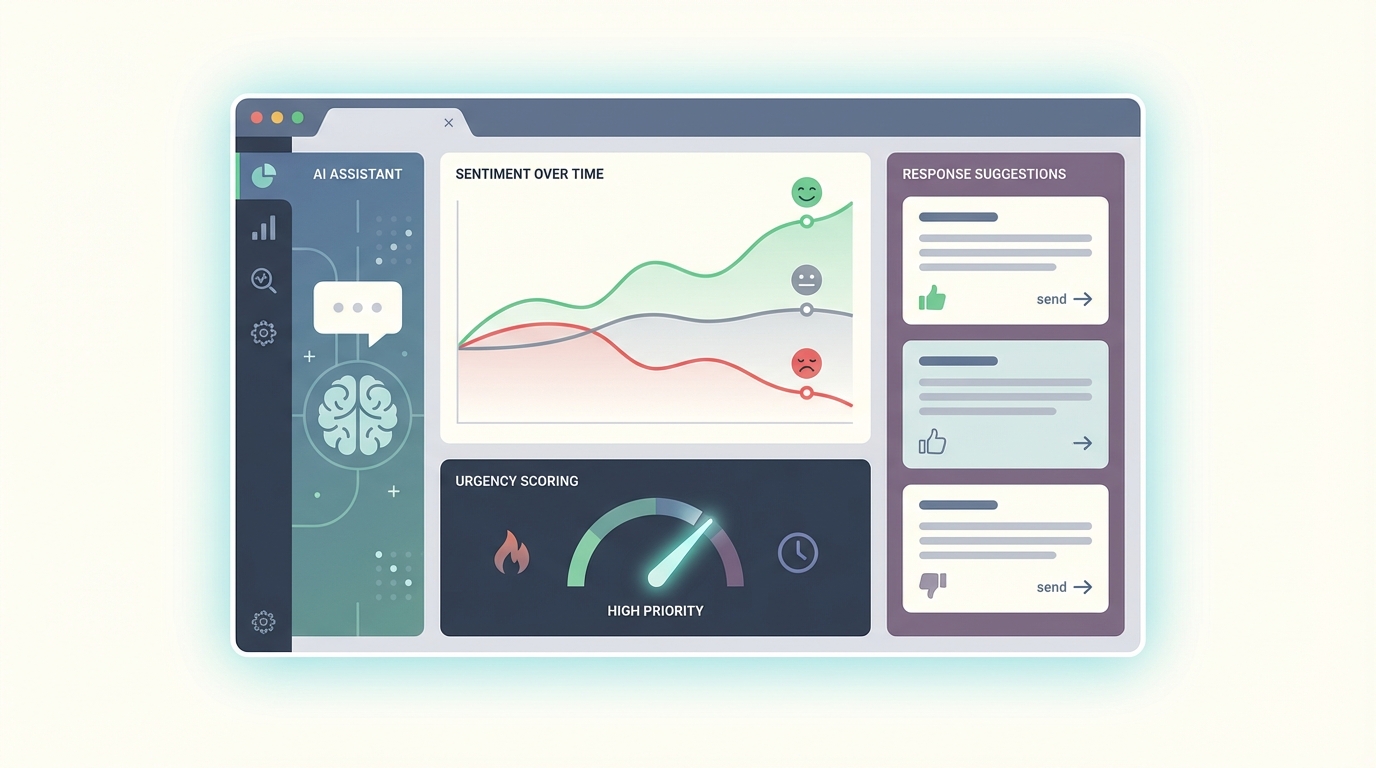
In 2026, AI handles the heavy lifting. It reads every review the moment it's posted, understands the nuance behind the words, scores the urgency, and drafts a response — all before your coffee gets cold.
This isn't hype. This is what modern review monitoring actually looks like.
How AI Powers Modern Review Monitoring
Sentiment Analysis
Traditional review analysis relied on star ratings. A 1-star review was bad, a 5-star was good, and everything in between was ambiguous. AI sentiment analysis goes much deeper:
Example review:
"The pasta was incredible, best I've had in years. But we waited 40 minutes for our table despite having a reservation. The host was rude about it too."
A human might rate this 3 stars. The star rating alone tells you nothing useful.
AI breaks it down:
- Food quality: positive (0.92 confidence)
- Wait time: negative (0.88 confidence)
- Staff behavior: negative (0.85 confidence)
- Overall sentiment: mixed, leaning negative
- Urgency: medium-high (staff rudeness mentioned)
This granularity means you know exactly what to address in your response and what to discuss with your team.
Urgency Scoring
Not all negative reviews are equally urgent. AI urgency scoring prioritizes based on:
- Severity — health complaints > slow service > minor inconvenience
- Legal risk — mentions of "lawsuit," "health department," "lawyer" trigger immediate escalation
- Influence — a bad review from someone with 500 reviews carries more weight than their first review
- Recency — a review about something that happened today is more actionable than something from last month
- Platform — Google review urgency is higher than a niche forum post due to visibility
MentionReview assigns each review an urgency score from 1–10, with configurable thresholds for alert routing.
Topic Extraction
AI identifies and categorizes the specific topics discussed in each review:
| Topic | Mentions This Month | Average Sentiment |
|---|---|---|
| Food quality | 45 | Positive (0.84) |
| Wait time | 23 | Negative (0.71) |
| Service | 38 | Mixed (0.52) |
| Ambiance | 12 | Positive (0.79) |
| Price/value | 18 | Neutral (0.48) |
| Cleanliness | 8 | Negative (0.35) |
This turns hundreds of individual reviews into actionable operational insights. You can see at a glance that cleanliness is your weakest area and food quality is your strongest.
AI Reply Suggestions
This is where AI saves the most time. Given a review, AI generates a response that:
- Acknowledges the specific complaint — not a generic "sorry for your experience"
- Matches the appropriate tone — formal for a professional complaint, warm for a positive review
- Follows proven frameworks — HEARD method (Hear, Empathize, Apologize, Resolve, Direct)
- Includes relevant details — mentions the reviewer's name, references their specific issue
- Offers resolution — suggests moving offline for negative reviews, thanks and invites back for positive
Example review:
"Waited 30 minutes for cold food. Server didn't check on us once. Won't be back."
AI-generated response:
"Hi [Name], thank you for letting us know about your visit. We're sincerely sorry that your food arrived cold and that our service fell short — a 30-minute wait and inattentive service is not what we aim for. I've shared your feedback with our kitchen and front-of-house teams, and we're taking steps to ensure this doesn't happen again. I'd love the opportunity to change your mind. Would you be open to reaching out to me at [email]? I'd like to personally invite you back. — [Manager Name]"
Time to write manually: 5–10 minutes. Time with AI: 10 seconds + a quick review.
AI Capabilities Available Today
Here's what AI can do for review monitoring right now, not in a theoretical future:
Real-Time Sentiment on Every Review
Every review is scored for sentiment the moment it's detected. No manual classification needed.
Automatic Categorization
Reviews are tagged by topic (food, service, price, location, staff, etc.) automatically. This feeds into trend dashboards.
Smart Urgency Alerts
AI decides who gets alerted and how urgently based on review content, not just star rating.
Response Drafting
One-click response generation that's context-aware and personalizable.
Trend Detection
AI identifies patterns before they become obvious. "Service sentiment has dropped 15% over the past 2 weeks" — that's AI catching a staffing problem before it shows up in your average rating.
Anomaly Detection
Sudden spikes in review volume or drops in sentiment trigger alerts. This catches things like competitor review spam, viral negative posts, or PR crises.
What AI Can't Do (Yet)
Perfect Response Every Time
AI drafts are good — often very good — but they still need a human review. Edge cases, sensitive situations, and highly personal complaints require human judgment.
Detect Fake Reviews Reliably
AI can flag suspicious patterns (multiple reviews from new accounts, similar language), but definitive fake review detection is still imperfect.
Replace Human Empathy
A customer who just had a terrible experience needs to feel that a real person heard them. AI can draft the words, but the decision to add a personal touch — or pick up the phone — is still human.
Understand Full Context
AI doesn't know that your restaurant was short-staffed because of a snowstorm, or that the "rude host" was actually a new hire on their first day. Human context still matters for internal action.
The ROI of AI-Powered Review Monitoring
Time Savings
| Task | Manual | AI-Assisted |
|---|---|---|
| Read & classify 1 review | 2 min | 0 sec (automatic) |
| Write response to 1 review | 8 min | 1 min (edit AI draft) |
| Daily review check (5 platforms) | 30 min | 0 sec (alerts come to you) |
| Monthly sentiment report | 4 hours | 5 min (auto-generated) |
For a business getting 100 reviews/month, AI saves approximately 20 hours per month on review management alone.
Faster Response = Better Outcomes
AI enables sub-hour response times, which improves:
- Customer satisfaction recovery rate (70% vs 25% for delayed responses)
- Review update rate (customers changing ratings after resolution)
- Local SEO ranking (Google rewards responsive businesses)
Operational Intelligence
The topic and trend analysis from AI gives you data that would be impossible to extract manually at scale. Knowing that "cleanliness" sentiment dropped 30% this week is actionable intelligence that directly impacts operations.
Choosing an AI-Powered Review Tool
When evaluating tools, look for:
- AI that's built-in, not bolted on — sentiment should run on every review automatically, not as an add-on module
- Transparent AI — you should see why AI scored something a certain way
- Customizable thresholds — your definition of "urgent" is different from another business's
- Editable AI responses — drafts you can customize, not auto-sent responses
- Multi-language support — if you serve diverse communities
MentionReview builds AI into every tier. Sentiment analysis, urgency scoring, and AI reply suggestions are included — not locked behind enterprise pricing.
Looking Ahead
The next wave of AI in review monitoring will likely include:
- Proactive suggestions — "Your Friday night staff may need support based on recent trends"
- Cross-platform correlation — connecting a negative Google review to a Reddit thread from the same customer
- Predictive scoring — flagging reviews that are likely to go viral before they do
- Voice and video analysis — understanding sentiment from review videos and Voice messages
The businesses that adopt AI-powered monitoring now will be well-positioned as these capabilities mature.
Experience AI-powered review monitoring. Start free with MentionReview. Sentiment, urgency scoring, and AI replies — all included.